


Redwood Materials Unveils Smart Battery Collection System


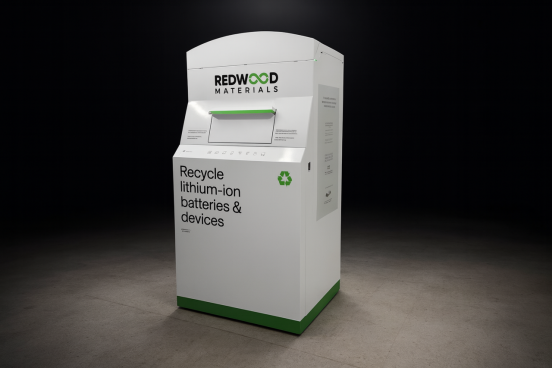
Photo Credit: Redwood Materials
Redwood Materials has introduced a new public-facing battery collection system designed to make recycling safer and more scalable, as U.S. regulators and recyclers grapple with rising fire incidents and low recovery rates for critical minerals, according to company reporting released this week.
The launch targets a persistent gap in the U.S. recycling system. While discarded electronics contain valuable lithium, cobalt, nickel, and copper, federal data show that only about one-sixth of consumer electronics are recycled nationwide, leaving most devices stored in homes or disposed of as waste. Industry analysts say the growth of lithium-ion batteries in everyday products has intensified both the economic stakes and the safety risks of improper handling.
Redwood, founded by former Tesla executive JB Straubel, has spent several years building collection networks through retailers, nonprofits, and mail-in programs. The newly announced Battery Bin represents a shift toward fully automated, in-store collection, aimed at reducing labor, preparation requirements, and fire exposure that have constrained traditional drop-off programs.
Unlike conventional battery boxes, which often rely on manual sorting and limited chemistries, the new system accepts mixed rechargeable batteries and battery-containing devices below a defined energy threshold. The unit uses internal sensors and automated packing logic to manage how items are stored, while continuously monitoring internal conditions. Observers note that fire-retardant cardboard containers, still common in retail settings, have drawn scrutiny after a series of waste facility fires linked to lithium-ion batteries over the past decade.
Redwood said the system transmits real-time operational data, including fill levels and system status, allowing centralized oversight and fewer on-site touch points. Industry groups argue that such monitoring could help address one of the sector’s biggest challenges: inconsistent handling practices across thousands of collection locations.
Collected materials will be transported to Redwood’s processing facilities in Nevada and South Carolina, where the company says it can recover more than 95% of battery metals. As an independent recycler, Redwood also routes non-rechargeable or incompatible materials to partner facilities, reflecting a broader trend toward specialization within the recycling supply chain.
Local regulators in San Francisco, a jurisdiction known for strict environmental and safety standards, have endorsed the system for public deployment, according to Redwood. Analysts say that approval could influence adoption in other cities as municipalities look to reduce fire risks without adding operational complexity.
The initial rollout will focus on the San Francisco Bay Area and Northern Nevada, with bins placed in retail and community locations. The company plans to expand nationally through partnerships with retailers, schools, and local governments, as demand grows for safer ways to manage end-of-life batteries.
Market participants estimate automated collection could play a larger role as extended producer responsibility programs and critical mineral supply concerns gain momentum in the U.S. Policy makers and recyclers alike are watching whether such systems can materially lift collection rates while keeping costs and risks in check.
Source: Redwood Materials
SUNSHINE Spotlight: Redwood’s new automated battery bin aims to raise U.S. recycling rates by making public collection safer, simpler, and scalable as lithium-ion devices proliferate.


