


MIT Engineers Develop Recyclable Elastic Yarn to Support Circular Textile Production


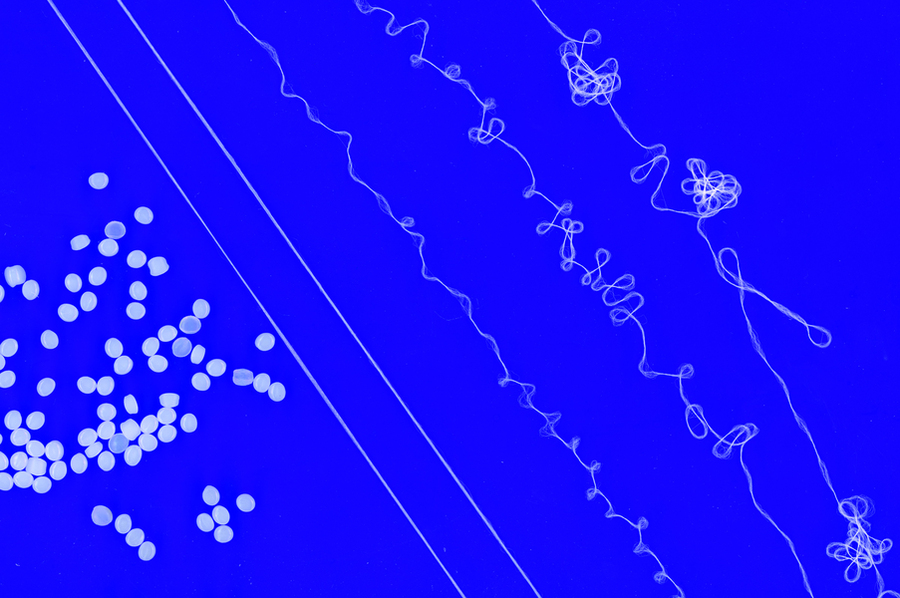
Photo Credit: MIT
According to industry reports, Researchers at the Massachusetts Institute of Technology (MIT) have developed a recyclable elastic yarn that matches the strength and stretch of conventional spandex-based yarns while enabling repeated recycling without significant performance loss. The innovation could provide a new pathway for reducing textile waste by replacing mixed-fiber elastic yarns that are difficult to recycle.
The research, published in ACS Materials Letters, introduces a polyethylene-based yarn that can be melted and remanufactured into new yarn or other plastic products at the end of its service life. The project was led by researchers from MIT's Department of Mechanical Engineering.
Unlike conventional elastic yarns, which combine a spandex core with polyester or nylon outer fibers, the new material is made entirely from different formulations of polyethylene. Because both the core and sheath belong to the same polymer family, the yarn can be recycled without the chemical separation required for traditional stretch fabrics.
The research addresses a major challenge facing the textile industry. According to the MIT team, approximately 80% of textiles sold in the United States contain spandex, making most stretch garments difficult to recycle. As a result, millions of tonnes of textile waste are sent to landfills or incinerators each year.
To develop the new material, the researchers selected two polyethylene-based resins with different mechanical properties. A more flexible resin was used to form the elastic core, while a stiffer polyethylene created the protective outer sheath. Both materials were melted, extruded into fine fibers and combined using conventional yarn-spinning equipment.
The team demonstrated the material's recyclability by repeatedly melting and respinning the yarn. After 10 recycling cycles, laboratory testing showed that the recycled yarn retained mechanical strength and flexibility comparable to the original material and to conventional elastic sewing threads.
“Eighty percent of textiles on the U.S. market currently contain some amount of spandex, which makes them nonrecyclable,” said Svetlana Boriskina, Research Scientist in MIT’s Department of Mechanical Engineering. “There’s no widely adopted technology now that recycles textiles into textiles. With our new yarn, we hope to change that.”
Lead author SeongHyeon Kim said the manufacturing process is relatively straightforward, with polyethylene pellets melted and extruded into fibers before being spun into yarn. The researchers believe the technology can be scaled using existing industrial fiber production equipment.
The team previously demonstrated polyethylene yarns with moisture-wicking, stain-resistant and cooling properties. The latest study extends the material’s capabilities by introducing elasticity comparable to spandex while maintaining recyclability.
Researchers envision the yarn being used in clothing and other stretch textile applications before being collected, remelted and converted into new yarn or plastic accessories such as buttons and buckles, supporting a closed-loop textile recycling system.
The project received support from the U.S. Army Research Office, the Office of Naval Research Global through Tecnológico de Monterrey, and the MIT Portugal Program.
Source: MIT
SUNSHINE Spotlight: MIT’s recyclable polyethylene yarn could offer a practical alternative to conventional spandex-based textiles, enabling repeated fiber-to-fiber recycling and supporting more circular textile manufacturing.


